

Conservation Dogs of Hawaiʻi - A Bird’s Best Friend, too?
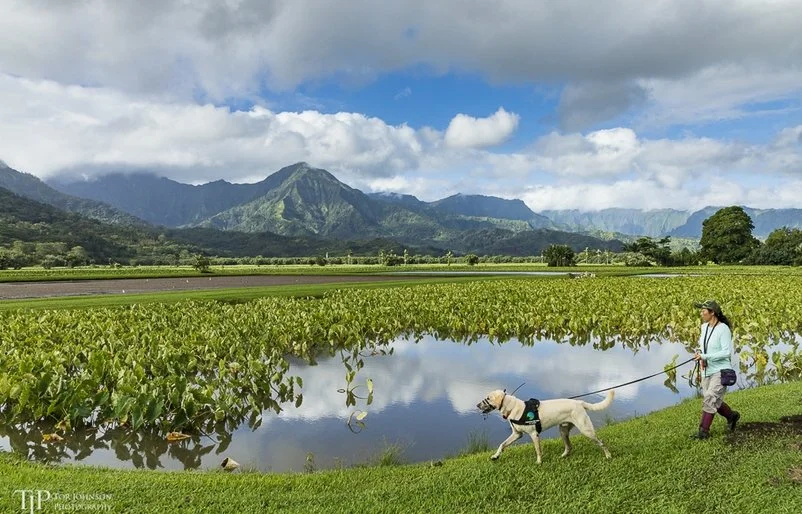
Kyoko Johnson and detection dog Solo survey a taro field at Hanalei National Wildlife Refuge. ©Tor Johnson
In 2017, Kyoko Johnson, founder of Conservation Dogs of Hawaiʻi (CDH), alongside her scent-detection dogs, performed a pilot study to locate freshwater native birds that are sick or dead from avian botulism at the Hanalei National Wildlife Refuge (HNWR) taro fields on Kauaʻi. The study was successful. Canine-aided searches found 97% more carcasses than by human sight alone, proving scent detection is a valuable conservation tool. The study's efficacy sparked Johnson to wonder if training dogs to find live downed seabirds during fallout season could work, too.
September through December is fallout season for Hawaiʻi's seabirds. Fallout is a phenomenon affecting young birds leaving their nest for the first time. Seabirds use light from the night sky to navigate to the ocean for food. Some fledglings that leave their nest for first flight end up attracted to, and confused by, the bright lights of shopping centers, schools, homes, parking lots, resorts and other buildings.
Confused birds circle continuously, disoriented by artificial light sources and often collide with buildings. Eventually tiring, the birds collapse to the ground, exhausted and unable to take off. Youngsters sit where they land or search for cover nearby, unable to navigate until they regain their strength. While waiting they risk becoming victim to predators in the area or may succumb to injuries from the fall.
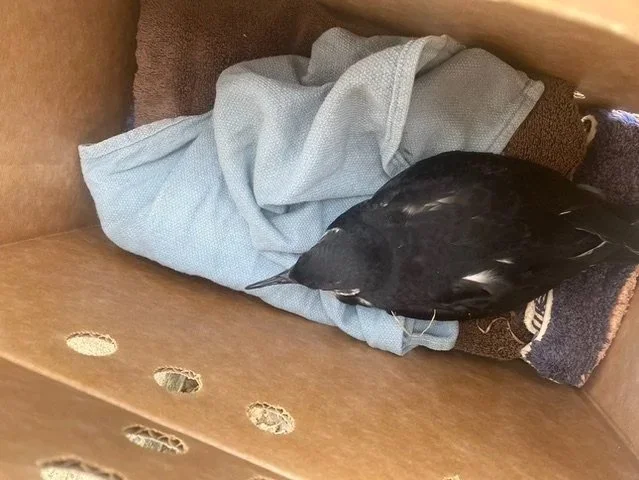
A rescued Newellʻs Shearwater rests in a box on the way to a rehabilitation center on Kauaʻi. © Conservation Dogs of Hawaiʻi
Residents of Kauaʻi are used to preparing for fallout season by keeping a box and towel in their car to facilitate rescues should they find a downed seabird. When resident rescuers find one they place a towel gently over its head and wings, scooping the bird up to put into the box. At the nearest fire station rescuers locate shearwater boxes, place the bird in the box, and call the rehabilitation center Save Our Shearwaters (SOS).
Twice a day, SOS workers collect, assess, and treat the birds as necessary. When the seabirds are deemed healthy they are released near the ocean at night. One issue, however, remains. Humans can only save the birds they can see and birds can hide well, which is where CDH stepped into the scene.
As Johnson originally trained dogs to find dead freshwater birds, she started training dogs to find live seabirds. CDH's program selects dogs that are calm, and not reactive or aggressive towards birds. Dogs learn target odors, complete scent tests, and learn how to display a passive alert when they locate a seabird. Dog handlers learn to read the subtle behaviors that indicate the dog may be close to finding a bird. Once dogs are active in the field, trainers use muzzles and leashes as additional precautions to ensure the safety of all birds.
On Oʻahu in 2022, the dogs got their chance to test their skills when CDH conducted a downed seabird detection trial with the assistance of U.S. Fish and Wildlife's Service Coastal Program Manager, Sheldon Plentovich. The trial was a success, resulting in a 90% detection rate. It was all the motivation CDH and its conservation partners needed to establish a "Seabird Rescue Patrol" on Kauaʻi. In the summer of 2023, CDH trained a team of dogs specifically for seabird scent. By September they were ready to start operational surveys. CDH could, of course, only train the dogs using seabird carcasses. Handlers hoped that the dogs would transfer their detection skills to live birds. And they did.

Xena hard at work on the scent trail. © Conservation Dogs of Hawaiʻi
In the early mornings of October 2023, CDH handler, Debra Gochros, and her dogs began regular surveys for downed seabirds on Kauaʻi. The team searched shopping areas and buildings several mornings each week. Gochros' dog, Xena, found two live, critically endangered Newell's Shearwaters. Incredibly, Xena detected each of the birds from 50-80 feet away.
Xena found the first seabird stuck in a chain-link fence. Xena worked the scent puzzle perfectly, her nose held high, as she scanned the air. Suddenly, Xena pulled Gochros into a ditch, up a hill, and through thick ground cover to a fence where they stopped. The dog gave a "sit alert" to communicate her find, indicating the trapped bird. Gochros and Xena waited for a volunteer to retrieve the Newell's Shearwater and transport the bird to the fire station for SOS to collect.
For further proof that the detection dogs' efforts were worthwhile, Xena found the second bird inaccessible under a dumpster. Gochros noticed a change in Xena's behavior pointing to the bird's hiding area. After moving the dumpster, the team rescued another bird. Thankfully, Johnson's idea to teach her dogs to locate live birds is a conservation success story.
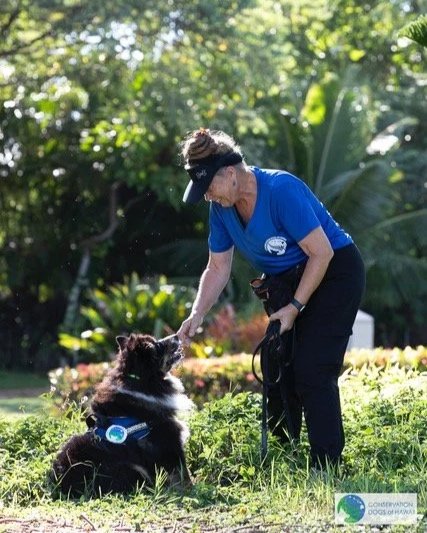
Gochros and her detection dog, Luna. © Conservation Dogs of Hawaiʻi
Training dogs to find and save birds is only part of CDH's mission. The dog teams are also skilled in various invasive species detections such as: the little fire ant, coconut rhinoceros beetle, rosy-wolf snail, melon fly, and devil weed, to name a few. Johnson says, "It's sight versus scent out here. When you have a needle in a haystack the canine nose is a highly accurate pinpoint."
As Hawaiʻi approaches another seabird fallout season, the CDH dog teams are gearing up for weekly downed seabird surveys on Kauaʻi. In addition, two more dog teams are in training. CDH also has plans to expand the organization's reach across the Hawaiian Island chain. Gochros says, "We're excited. We hope to be able to save more birds this fallout season." With man's best friend hot on the trail, it's clear the seabirds of Hawaiʻi have another dedicated partner looking out for their survival and protection.
Originally published in ʻElepaio, Volume 85, Number 5 (September/October 2024).