

Holding the Mosquito Line: Maui’s Fight to Save Its Honeycreepers
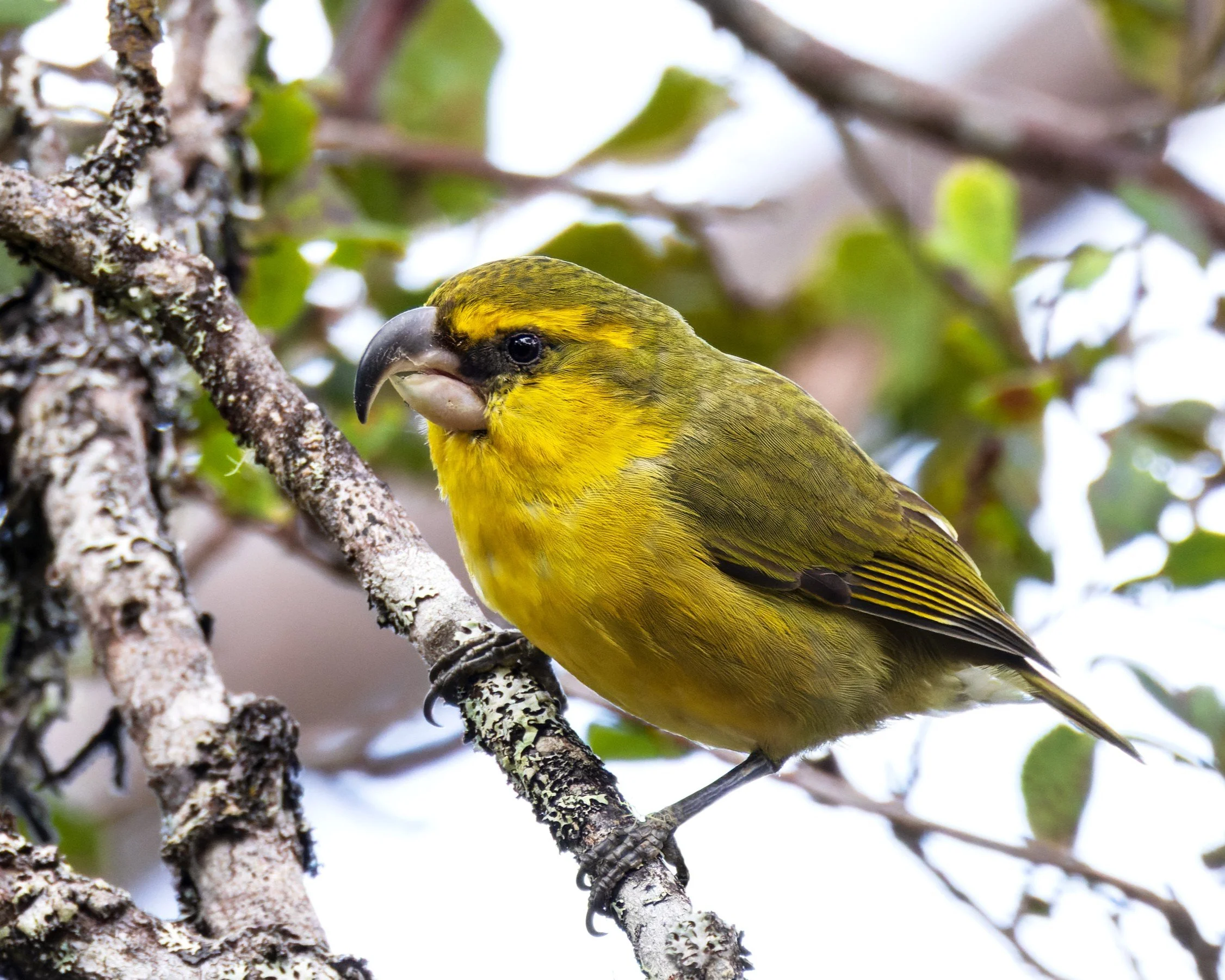
Kiwikiu (Maui Parrotbill, Pseudonestor xanthophrys) in a high-elevation forest on Maui. © Maui Forest Bird Recovery Project
The helicopter steadily rises, its rotors scattering a light mist above the upper canopy of ʻōhiʻa lehua (Metrosideros polymorpha) and koa (Acacia koa). Below, technicians move along a narrow ridge trail with CO₂ tanks and batteries, the forest still wet from overnight rain. Somewhere in this landscape, avian malaria-carrying mosquitoes now occupy elevations once considered safe for Maui's native birds.
Across Hawaiʻi, warming temperatures have pushed the mosquito "line" upslope, eroding the last disease-free refuges for species such as kiwikiu (Maui Parrotbill, Pseudonestor xanthophrys) and ʻākohekohe (Crested Honeycreeper, Palmeria dolei). Maui now offers a close look at how the Incompatible Insect Technique (IIT) is being adapted to wildlife conservation in steep, remote forests where access often depends on helicopters and, increasingly, drones.
Along a GPS-guided flight line, biodegradable paper-pulp pods fall through gaps in the canopy, each carrying about a thousand incompatible male mosquitoes. The Maui landscape-scale effort to combat avian malaria began November 2023, while Kauaʻi started their releases in February 2025.
Here, we offer an updated look at Maui's landscape and one turning point in the broader effort to reduce mosquito-borne disease in Hawaiʻi's forests.

Remote, steep forest terrain in a high-elevation landscape on Maui. © Maui Forest Bird Recovery Project
A High-Elevation Turning Point
For decades, Hawaiʻi's high elevation forests served as the final refuge for native honeycreepers. Avian malaria (Plasmodium relictum) is most prevalent in warm, low-elevation areas and becomes less common upslope as temperatures drop—a pattern that historically limited both mosquito activity and parasite development (Samuel et al., 2015). These conditions allowed species such as kiwikiu, ʻākohekohe, and ʻiʻiwi (Scarlet Honeycreeper, Drepanis coccinea) to persist long after disappearing from much of their former range.
By 2019, MFBRP initiated a carefully planned translocation of kiwikiu into Nakula. For a brief time, the forest held the species' calls again. But within weeks, birds showed severe illness or disappeared. Necropsies confirmed avian malaria. Despite Nakula's elevation, mosquito densities and infection rates were far higher than anticipated.
The losses echoed what climate-driven disease models had warned: rising temperatures would push malaria transmission into elevations once considered safe (Liao et al., 2017). Nakula highlighted the urgency of mosquito control. The question was no longer whether action was needed, but how quickly it could begin.
A New Tool for a Changing Forest
Conservation strategies for Hawaiian honeycreepers have long included habitat restoration, predator management, and translocations to safer locations (Samuel et al., 2015). These tools remain essential, but none were designed to counter a rapidly expanding disease front.
The Incompatible Insect Technique (IIT) offers a new option. Male mosquitoes are reared with a specific Wolbachia strain, a naturally occurring bacteria; when they mate with wild females carrying a different or no strain, their eggs fail to hatch. Only non-biting males are released, and no genetic modification is involved. Repeated releases can suppress wild mosquito populations (U.S. Fish and Wildlife Service [USFWS], 2023a; McClure, 2020).


IIT has been successfully used internationally to reduce mosquito-borne diseases in humans. In Hawaiʻi, the method is being adapted not for urban neighborhoods, but for steep, cloud-covered native forests where access requires aircraft. Kauaʻi and Maui are central to this work because they are home to the most imperiled native forest bird populations. In 2023, following similar environmental review and public consultation processes, state and federal agencies approved IIT for both islands — including tens of thousands of acres of East Maui forest and portions of Haleakalā National Park (USFWS, 2023b).
Releasing Millions in a Moving Cloudbelt
In November 2023, MFBRP and partners began the first landscape-scale IIT deployments on Maui, using twice-weekly helicopter flights to distribute incompatible male mosquitoes across approximately 3,000 acres of middle-elevation forest. These aircraft remain the backbone of the program, capable of covering steep, cloud-draped terrain. Aboard the helicopter, two technicians work closely—one drops the pods loaded with Wolbachia-infected males through a custom-designed chute, while the other calls out the timing for each drop.
Beneath the canopy lies a patchwork of microhabitats—bogs, tree-fern cavities, and puddled stream margins—that support breeding for the southern house mosquito (Culex quinquefasciatus) (LaPointe, 2024). Release points are distributed to apply approximately ten incompatible males for every wild male per acre across the landscape, increasing the likelihood that female mosquitoes encounter and mate with an incompatible male.
While helicopters remain essential, supplemental drone-based releases have expanded the release window when helicopters aren't available. As technology advances, drones are expected to play a larger role.

Under misty, low-visibility conditions, MFBRP team members prepare a drone for mosquito pod deployment, extending release operations beyond helicopter availability. © Maui Forest Bird Recovery Project
Implementing IIT in Maui's forests requires constant adaptation to shifting weather, complex winds, shipment schedules, and narrow flight windows. During the first year, more than 25 million incompatible males were released. Maui's and Kauaʻi's field experiences are now informing statewide protocols and demonstrating how IIT can be scaled to other islands.
Currently, all incompatible males used in Hawaiʻi are reared on the mainland and shipped weekly. This system enabled early implementation but is vulnerable to transport delays and cannot support statewide expansion. Conservation partners are evaluating the development of on-island rearing facilities to stabilize supply and support long-term mosquito suppression.
The goal is simple in concept and demanding in practice: release enough incompatible males, for long enough, that the invasive mosquito population—and thus avian malaria—declines. Because IIT cannot treat all parts of the islands, and fertile mosquitoes can fly in from non-treated areas, IIT releases need to be maintained indefinitely to reliably protect native birds.
Making the Invisible Visible: Monitoring IIT in the Forest
To evaluate whether IIT is working, MFBRP maintains monitoring stations across treated and comparable non-treated areas, building on more than a decade of research into mosquito abundance and disease transmission in Hawaiian forests (Ahumada et al. 2024).
MFBRP tracks three primary indicators:
1. Adult mosquito trapping
CO₂-baited traps collect mostly wild females and some males, allowing researchers to estimate mosquito density, sex ratios, and the proportion of released IIT males relative to wild males.
2. Egg raft sampling
Basins filled with fermented hay-water attract gravid females. Egg rafts are collected and hatched in the lab; a high proportion of unhatched eggs indicates successful incompatible matings.
3. Larval surveys
Teams inspect standing water across streams, feral pig wallows, and natural containers such as tree-fern cavities to document changes in larval abundance over time and identify larval breeding habitats.
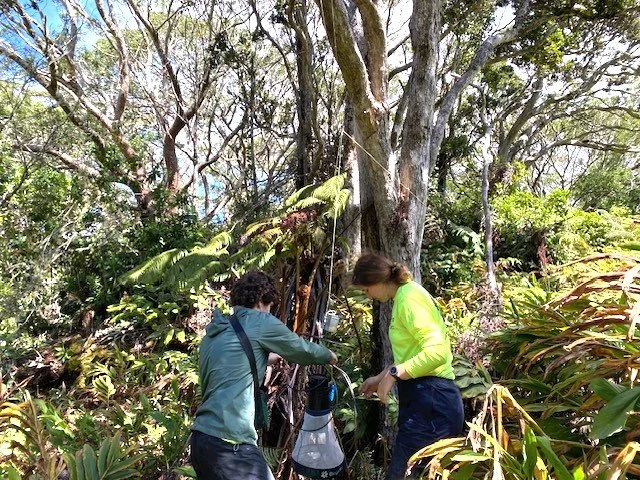

Mosquito populations fluctuate with rainfall and temperature; single sampling events therefore provide only limited inference. Multi-year datasets are essential to distinguish short-term variability from sustained suppression. Bird population responses lag even further: slow-reproducing honeycreepers such as kiwikiu and ʻākohekohe may take years to show measurable demographic improvement once malaria pressure declines.
Kuleana to Birds Most People Will Never See
Most residents and visitors on Maui and the Hawaiian Islands will never see kiwikiu or ʻākohekohe. Yet decisions made today—in boardrooms, labs, and helicopter staging areas—will determine their future.

‘Ākohekohe (Palmeria dolei), an endemic Maui honeycreeper whose survival depends on continued protection of Hawai‘i’s remaining native forests. © Maui Forest Bird Recovery Project
Native forest birds anchor both the ecological and cultural integrity of Hawaiʻi. Ecologically, their feeding, pollination, and seed dispersal sustain native plant communities and the health of the forest canopy. Culturally, these birds carry stories that stretch back to creation, appearing in the Kumulipo and traditional mele and oli as embodiments of place, ancestry, and guidance. Their loss would erode not only the forests themselves but the cultural knowledge and relationships connected to them. Protecting them is part of honoring the reciprocal responsibilities—kuleana—that tie people to the ʻāina.
Research documenting climate-driven disease expansion and rapid avian population decline has been sobering (Paxton et al., 2016; Howard, 2017; Liao et al., 2017). IIT offers a landscape-scale tool that did not exist a generation ago: a way to reduce mosquito populations without genetic modification or broad-spectrum pesticides (USFWS, 2023a; McClure, 2020).
IIT alone cannot secure the long-term survival of Hawaiian forest birds. It must operate alongside habitat protection, predator control, and continued development of additional tools. On Maui, IIT serves as a critical bridge—an effort to hold the line against extinction while broader strategies advance (LaPointe, 2024; USFWS, 2023a).
If successful, establishing an on-island mosquito-rearing facility and sustaining IIT at landscape scale would represent one of the most significant conservation achievements in Hawaiʻi's history—an example of a One Health approach, in which reducing vector populations, safeguarding native forest birds, and sustaining healthy ecosystems also contributes to the well-being of the human communities connected to them. Continued investment in this work will determine whether Kauaʻi's and Maui's honeycreepers persist in the decades ahead.
As evening settles and the helicopter's rotor noise fades, a CO₂ trap runs quietly in the understory. Inside the trap's catch bag, the day's pattern becomes visible: fewer wild females—small signals that, over time, the mosquito line may begin to shift downslope.
What happens next will determine whether future generations on Maui know kiwikiu and ʻākohekohe as living birds or only as photographs and museum specimens. For now, the work is still unfolding—one flight, one trap, and one egg raft at a time.
Continued progress depends on sustained funding and community support. To learn more about the Maui Forest Bird Recovery Project, the Kauaʻi Forest Bird Recovery Project, Birds, Not Mosquitoes, and how to contribute to mosquito suppression and forest bird recovery in Hawaiʻi, visit:
https://www.mauiforestbirds.org/
https://kauaiforestbirds.org/
https://www.birdsnotmosquitoes.org/
Acknowledgments
Many thanks to the Maui Forest Bird Recovery Project team, particularly Jessica Eden and Christa Seidl, for sharing data and operational details, and for reviewing the manuscript for scientific and project accuracy.
References
Ahumada, J. A., Lapointe, D., & Samuel, M. D. (2004). Modeling the population dynamics of Culex quinquefasciatus(Diptera: Culicidae) along an elevational gradient in Hawaiʻi. Journal of Medical Entomology, 41(6), 1157–1170. https://doi.org/10.1603/0022-2585-41.6.1157
Howard, J. (2017). Can biotechnology stop Hawaiʻi's invasive mosquitoes? ʻElepaio, 77(4), 25–27. (Reprinted from Bird Conservation, American Bird Conservancy).
LaPointe, D. A. (2024). Assessing mosquito populations to limit the spread of avian disease and inform the conservation of Hawaiian forest birds (Final project report). U.S. Geological Survey, Pacific Island Ecosystems Research Center. https://pubs.usgs.gov/publication/70264070
Liao, W., Atkinson, C. T., LaPointe, D. A., & Samuel, M. D. (2017). Mitigating future avian malaria threats to Hawaiian forest birds from climate change. PLOS ONE, 12(1), e0168880. https://doi.org/10.1371/journal.pone.0168880
McClure, K. (2020, July 1). Landscape-level mosquito suppression to protect Hawaiʻi's rapidly vanishing avifauna. Cornell K. Lisa Yang Center for Wildlife Health. https://wildlife.cornell.edu/blog/landscape-level-mosquito-suppression-protect-hawaiis-rapidly-vanishing-avifauna
Paxton, E. H., Camp, R. J., Gorresen, P. M., Crampton, L. H., Leonard, D. L., & VanderWerf, E. A. (2016). Collapsing avian community on a Hawaiian island. Science Advances, 2(9), e1600029. https://doi.org/10.1126/sciadv.1600029
Samuel, M. D., Woodworth, B. L., Atkinson, C. T., Hart, P. J., & LaPointe, D. A. (2015). Avian malaria in Hawaiian forest birds: Infection and population impacts across species and elevations. Ecosphere, 6(6), Article 104. https://doi.org/10.1890/ES14-00393.1
U.S. Fish and Wildlife Service. (2023a). Saving Kauaʻi forest birds: Final environmental assessment of using incompatible insect technique for mosquito suppression. U.S. Department of the Interior. https://www.fws.gov/media
U.S. Fish and Wildlife Service. (2023b, October). Saving Kauaʻi forest birds. https://www.fws.gov/press-release/2023-10/saving-kauai-forest-birds
Originally published in ʻElepaio, Volume 86, Number 1 (January/February 2026).