

Sharing the Canopy: Building Skills to Protect Honolulu’s White Terns

Rich Downs engages with arborists during the morning session of the Arborists Guide: Protecting Manu o Kū During Tree Work workshop at Kapi‘olani Community College. © Laura Doucette
Honolulu's urban canopy supports one of the city's most distinctive seabirds: the Blue-billed White-Tern (Gygis candida), or manu o Kū, the official bird of the City and County of Honolulu. Unlike most birds, manu o Kū place their eggs directly on open branches without constructing a nest, making their breeding success closely tied to the care and management of the trees they depend on.
In Honolulu, this responsibility often falls to arborists, grounds crews, and tree care professionals working at the front lines of the urban forest. Their daily decisions—how and when to trim, where to climb, when to pause work—play a critical role in protecting manu o Kū while also maintaining public safety and healthy trees. The continued presence of this seabird in the city demonstrates that coexistence between people and native wildlife is not only possible, but already occurring through informed, careful tree care.
Addressing a Growing Need Through the Kaulunani Grant Program
In recent years, Hawaiʻi Audubon Society (HAS) and its partners observed recurring challenges: inconsistent trimming practices near breeding sites, uncertainty among crews about identifying active tern use, and limited training opportunities focused on urban wildlife considerations. These concerns coincided with growing interest in both urban forest care and manu o Kū conservation, creating an opportunity to link the two.
To help meet this need, HAS applied for a Kaulunani Urban & Community Forestry Program grant under the statewide "Year of Our Community Forests 2025" initiative. Kaulunani, administered by the Hawai'i Department of Land and Natural Resources Division of Forestry and Wildlife in partnership with the USDA Forest Service, supports projects that strengthen community forestry through education, outreach, and practical demonstration.
HAS's proposal focused on expanding professional and community knowledge of tern-sensitive tree work, producing educational materials that translate technical guidance into accessible practices, and hosting a live case-study tree-trimming event to demonstrate safe, ecologically informed techniques. The grant provided the foundation for the 2025 workshop and related outreach efforts, supporting planning, equipment needs, training materials, student engagement, and coordination among arborists, biologists, and educators.
Collaborative Planning Grounded in Experience
Following the award, HAS convened partners from the Aloha Arborist Association, Western Chapter International Society of Arboriculture, Donahue Arborist, Tree Solutions Hawaii, U.S. Fish and Wildlife Service, Hawai'i DLNR, Pacific Rim Conservation, Delphi Cinema, Hui Manu o Kū, and Kapi'olani Community College (KCC). Planning meetings throughout the year focused on adapting the 2019 Best Management Practices (BMP) document into a practical training curriculum and identifying areas where arborists frequently encounter uncertainty—such as interpreting adult bird behavior, recognizing potential nesting surfaces, and adjusting work approaches in tern habitat.
KCC was selected as the workshop site through the longstanding collaboration between HAS and two of its board members—Dr. Wendy Kuntz, Ecology Professor at Kapi'olani Community College, and Rich Downs of Pacific Rim Conservation and the Hui Manu o Kū. The campus provided a setting that supported both classroom instruction and outdoor demonstrations. KCC grounds staff worked closely with the team to designate appropriate trees and ensure the site could safely accommodate a large group, strengthening the partnership between HAS and KCC.
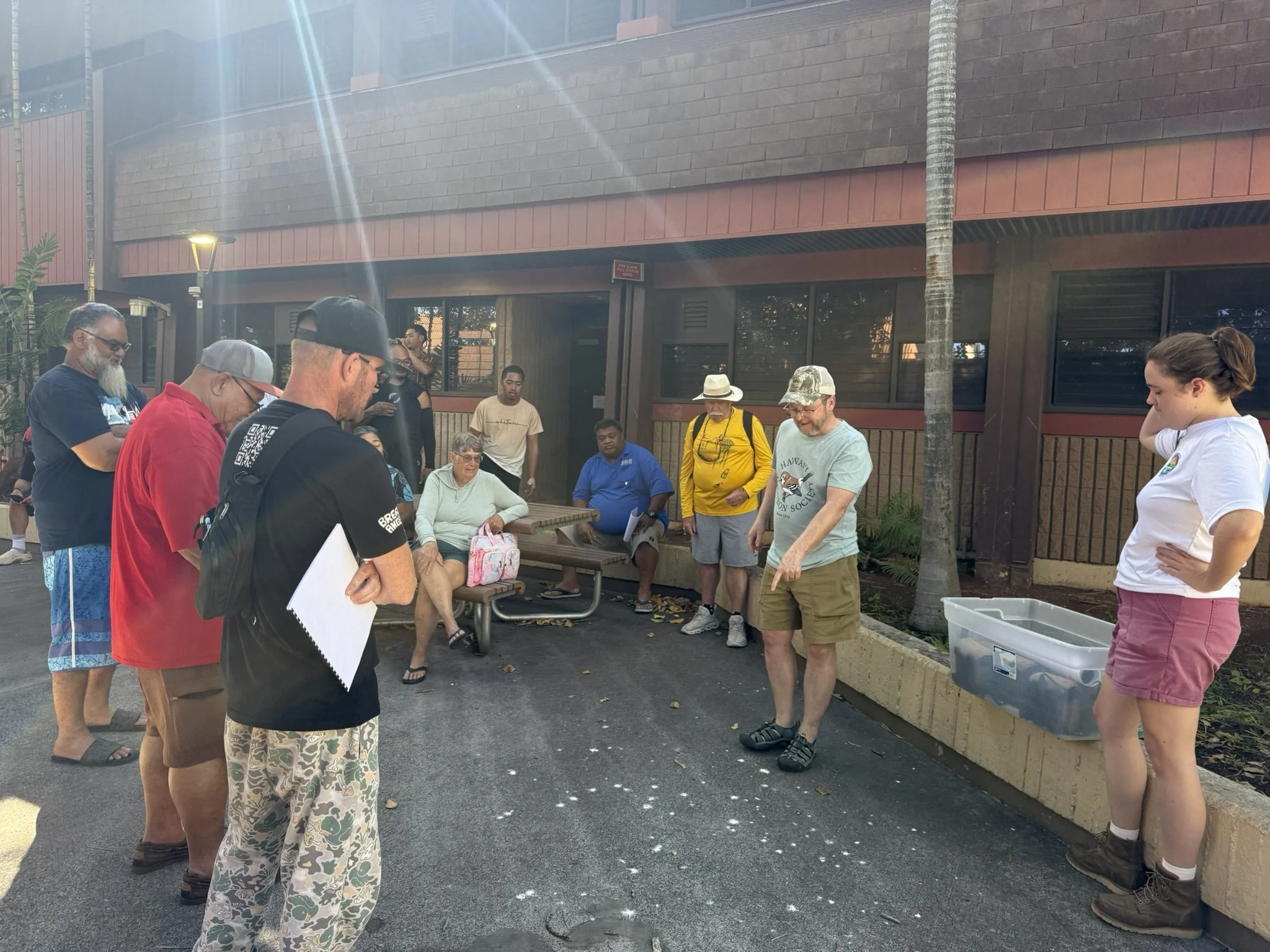
Keith Swindle identifies manu o Kū guano, or white wash, on the ground at the Kapiʻolani Community College Campus for afternoon workshop participants, indicating the likely location of an active nesting site overhead. © Wendy Kuntz
A Training Designed for Professional Arborists, Homeowners and Students
The workshop was originally planned as a two-track event: arborists in the morning and homeowners and students in the afternoon. Once registration opened, the audience shaped itself. Arborists working daily across Honolulu's urban core filled the roster quickly, while homeowner enrollment remained low and a small group of KCC students registered to assist and attend. Because the strongest demand came from those responsible for tree care on a daily basis—commercial crews, municipal contractors, and city grounds staff—HAS adjusted the schedule and offered the full professional session twice.
Each session began in KCC's Koki'o STEM Center, where participants received an overview of manu o Kū biology and the behavioral cues most relevant to tree work. Instructors Rich Downs and Keith Swindle—a former Criminal Investigator and Biologist for the U.S. Fish and Wildlife Service and current HAS Executive Director—outlined legal considerations guiding trimming around protected wildlife, including the Migratory Bird Treaty Act and applicable state regulations. They reviewed key recommendations from the BMP document and emphasized pre-work assessments: scanning trees before climbing, identifying signs of recent tern activity, and planning work sequences when wildlife may be present.
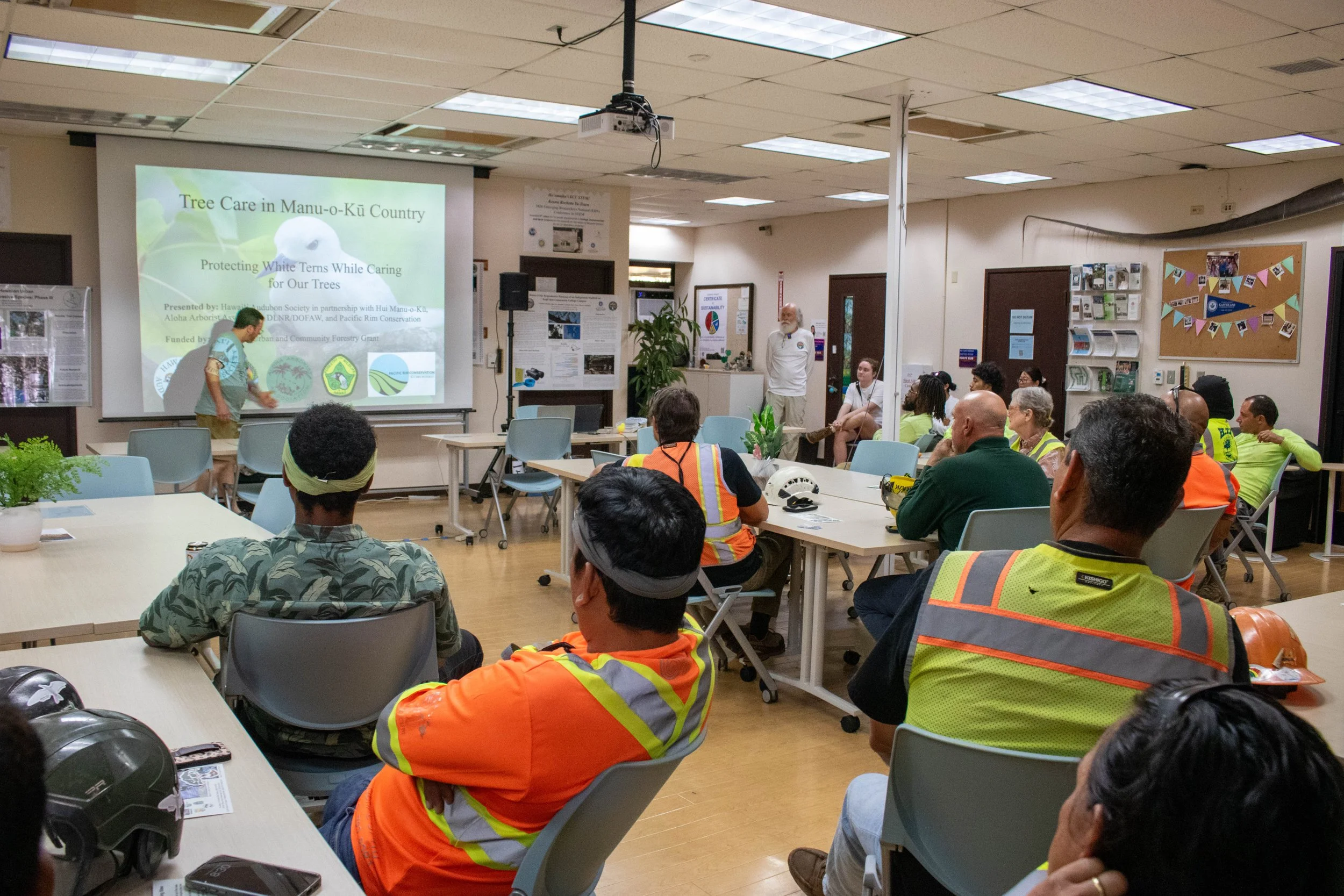
Keith Swindle and Rich Downs lead the morning session for arborists on manu o Kū breeding biology, behavior, and applicable migratory bird protections. © Laura Doucette
The indoor training also addressed what to do if a downed chick or adult bird is encountered during tree work. Participants were instructed to contact the Manu o Kū Hotline at (808) 379-7555, and arborists later received helmet and vehicle stickers with the number so it would be readily accessible in the field.
Outside, certified arborists Justin Donahue of Donahue Arborist and Ilana Nimz of Tree Solutions Hawaii—Nimz also a wildlife biologist—led a live trimming demonstration designed to model safe, wildlife-aware practices. Because the workshop took place after peak breeding season and no reliable chicks were present in the selected trees, trainers placed a stuffed bird decoy in the canopy, allowing participants to practice identifying likely nesting surfaces, moving around the bird while in the tree canopy, and recognizing subtle indicators of past tern use.
Participants worked through observational exercises that emphasized reading the birds themselves. Trainers highlighted behavioral cues—flushing, head turns, upright postures, or small changes in stance—that should guide decisions in real time rather than relying on fixed distance rules alone. The demonstration reinforced that careful observation and responsiveness to individual birds are central to wildlife-safe tree care.
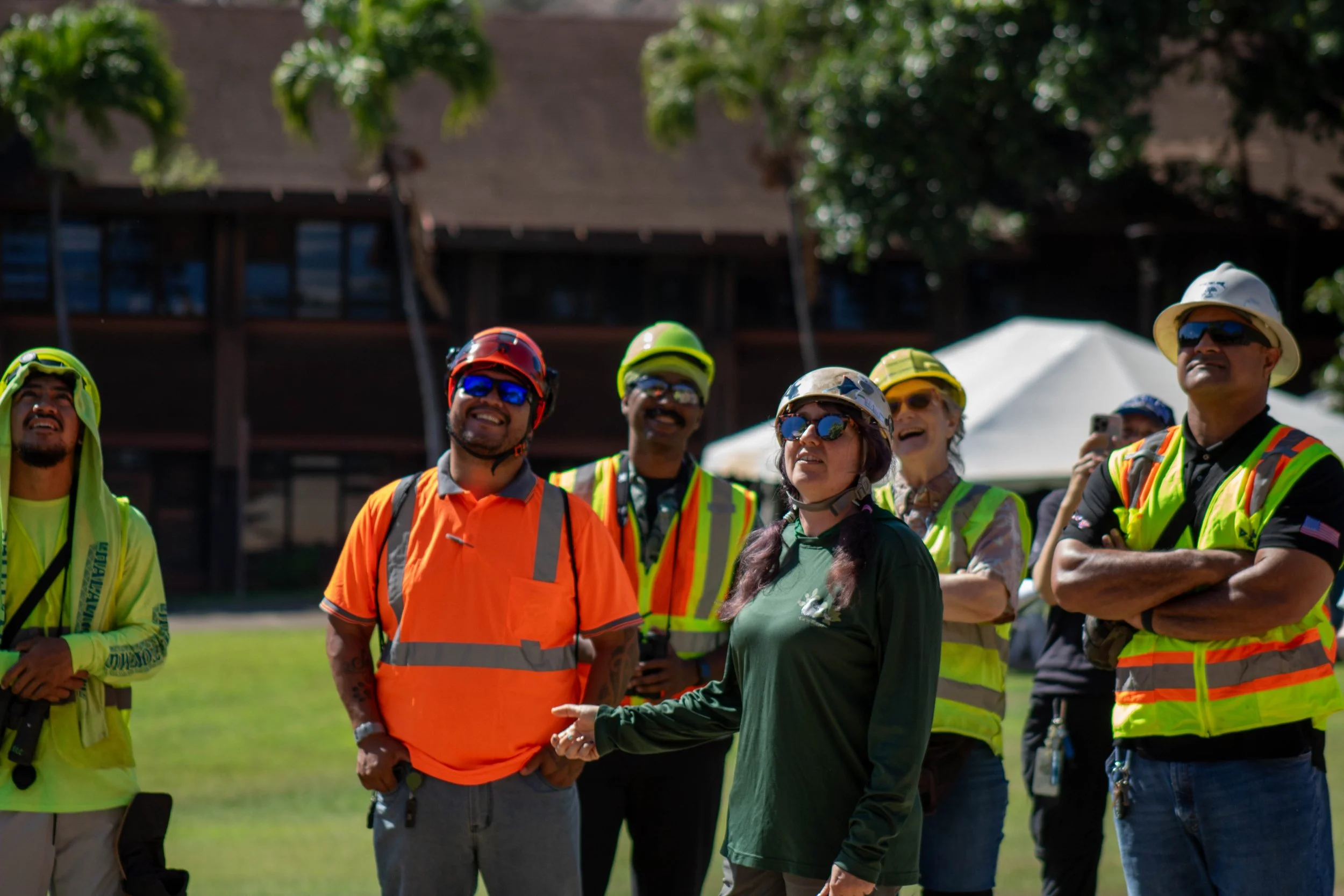
Ilana Nimz explains wildlife-aware tree care practices to professional arborists, as Justin Donahue demonstrates climbing and trimming techniques in the tree canopy above. © Laura Doucette
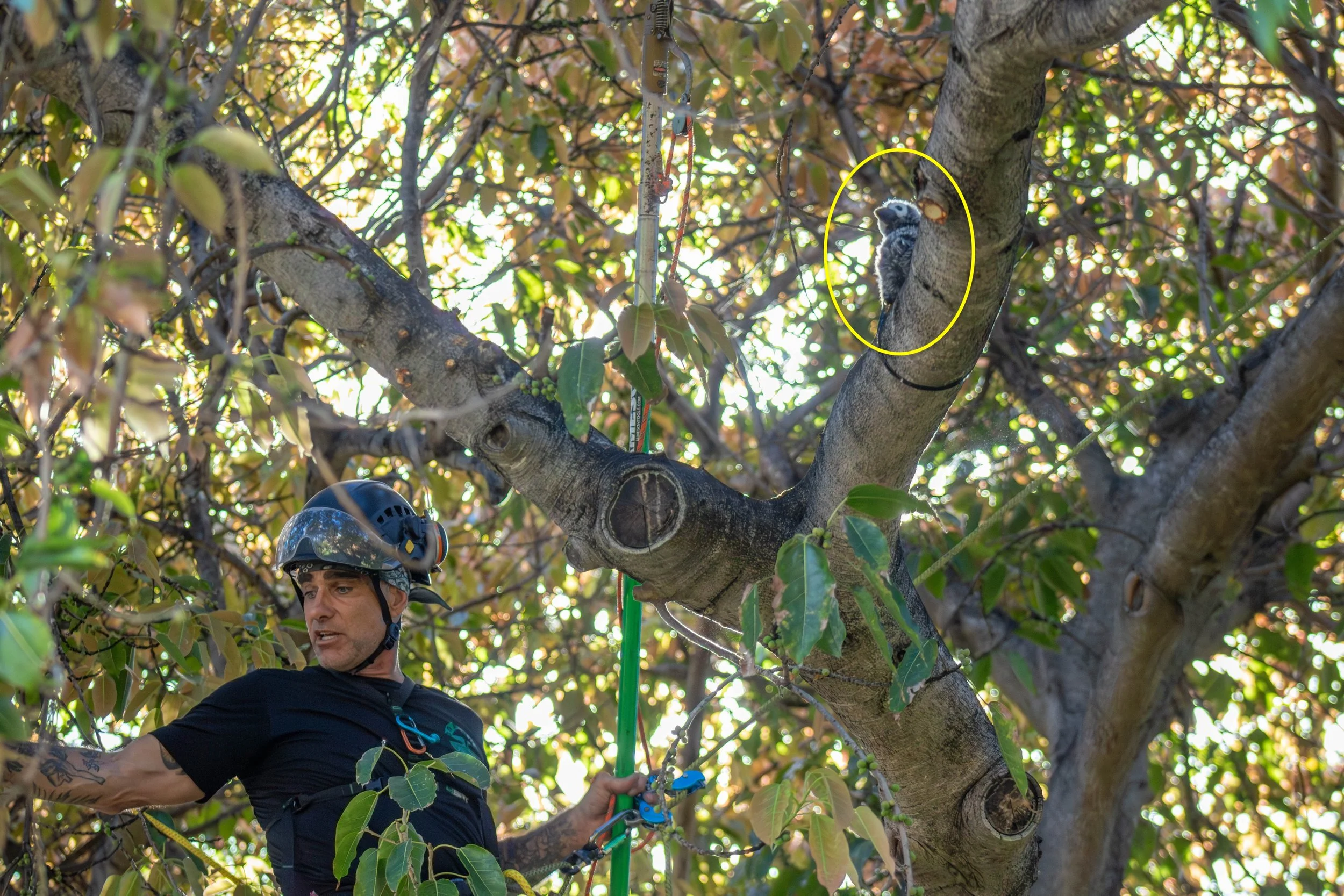
Justin Donahue works in the tree canopy during a live demonstration, using climbing aids and a pole saw around a stuffed bird decoy (circled) to model wildlife-aware movement and cutting techniques. © Laura Doucette
The demonstration also highlighted the equipment and techniques arborists rely on in the canopy. Justin Donahue used ropes, climbing aids, hand saws, a pole saw, and an electric chainsaw to demonstrate how professional tree workers move safely through a tree and make controlled cuts while remaining attentive to nearby wildlife. KCC grounds staff collaborated with the training team to select demonstration trees, establish safe viewing areas, and assist with cleanup after each session.
Across both sessions, more than 40 attendees—from commercial tree companies, municipal crews, campus operations, conservation organizations, state agencies, students, and community members—observed how practical trimming techniques intersect with careful, real-time assessment of manu o Kū behavior in an active urban environment.

Participants engage in a closing group discussion during the professional arborist training, with instructors Justin Donahue and Ilana Nimz responding to questions following the live demonstration. © Laura Doucette
Developing Educational Video Resources
Another major component of the Kaulunani project is the development of video-based educational materials designed to extend the reach of the workshop beyond in-person training. Hawai'i Audubon Society contracted with Delphi Cinema to produce a video that reinforces the core concepts presented during indoor instruction and applies them to real tree work.
The video centers on a key message of the grant: arborists are frontline stewards of Honolulu's urban canopy, and their daily work plays a critical role in protecting manu o Kū. Footage of Justin Donahue working in a tree provides visual context for applying wildlife-sensitive practices when birds are present. Once completed, the video will serve as an accessible training resource for arborists, students, and community members unable to attend in-person sessions.
Strengthening Urban Forest Stewardship Through Partnership
Beyond the technical training, the workshop created opportunities for arborists, biologists, campus staff, and students to compare experiences and discuss the realities of working in Honolulu's urban canopy. These exchanges helped bridge gaps between wildlife conservation, day-to-day tree care operations, and campus-based monitoring efforts.
KCC students shared details from ongoing projects documenting manu o Kū activity on campus, including mapping sightings, noting breeding behavior, and tracking frequently used trees. Their observations illustrated how student-led monitoring can complement professional tree care and conservation work. Hui Manu o Kū rescuers also offered a hands-on demonstration, explaining how fallen manu o Kū chicks are assessed, safely handled, and returned to their specific nesting trees using established rescue methods and tools.

Kapi‘olani Community College students Charlotte Bender and James Lee discuss campus-based manu o Kū monitoring and research projects with arborists during the workshop. © Laura Doucette

Hui Manu o Kū rescuers Sora Gallo (left) and Kelly Furuya (right) demonstrate chick rescue techniques, explaining assessment methods, handling protocols, and the specialized tools used to safely return fallen chicks to their nesting trees. © Elena Arinaga
The impact of the training became evident soon after the workshop. Within a week, an arborist who attended contacted the manu o Kū hotline to report what is believed to be the first documented case of manu o Kū nesting at the National Memorial Cemetery of the Pacific (Punchbowl). The arborist noticed fresh droppings beneath a shower tree, looked up, and identified a chick—applying the same observational cues emphasized during the training.
The Kaulunani grant project underscored the close connection between Honolulu's trees and the wildlife that depend on them, reinforcing practices that allow arborists to protect wildlife while continuing their essential work. Thoughtful tree care—grounded in science and supported by collaborative training—is central to protecting manu o Kū and maintaining a resilient urban forest. HAS and its partners intend to build on the success of the 2025 workshop through continued outreach, educational materials, and future training opportunities that strengthen shared stewardship of the city's canopy.
This project was supported by the Kaulunani Urban & Community Forestry Program of the Hawai'i Department of Land and Natural Resources Division of Forestry and Wildlife and the USDA Forest Service as part of the Year of Our Community Forests 2025 initiative.
Editorial note: Bird naming conventions continue to evolve. The name(s) used here reflect current standardized usage at the time of publication.
Originally published in ʻElepaio, Volume 86, Number 1 (January/February 2026).