

A Song Returns to Kuaihelani: The Laysan Finch Translocation of 2025
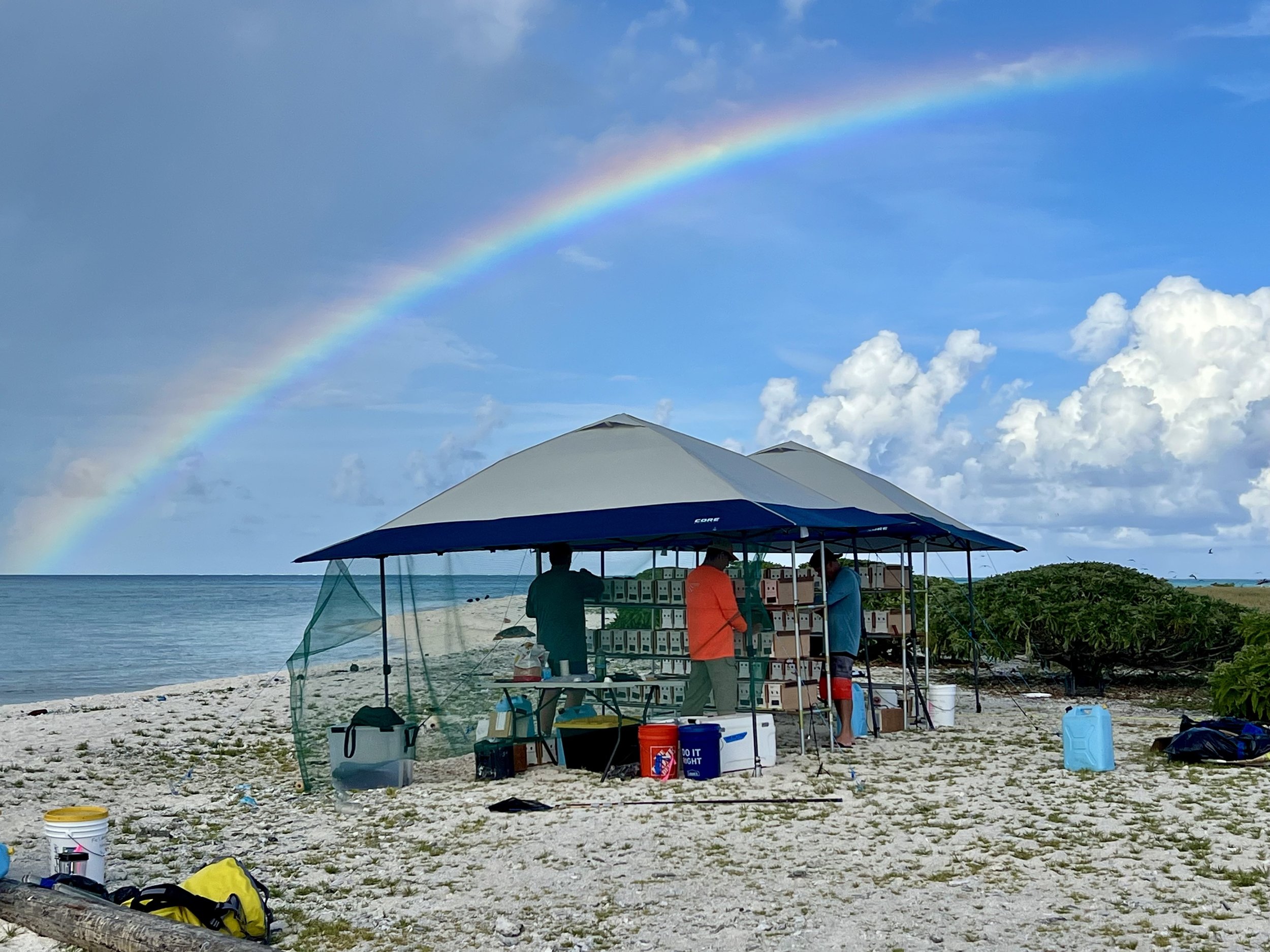
A temporary field station on Manawai used to process ‘ekupu‘u—each Laysan Finch (Telespiza cantans) was weighed, measured, banded, and recorded prior to transport to Kuaihelani. © Sheldon Plentovich, USFWS
In July 2025, a sound long absent from Kuaihelani (Midway Atoll) returned—the melodic trills, whistles, and warble-like song of the Laysan Finch ('ekupu'u; Telespiza cantans). For the first time in eight decades, their voices carried across the wind-shaped vegetation of Midway's Eastern Island. This moment marked the culmination of a complex and collaborative translocation effort designed to bolster the resilience of this endangered species, long absent from its ancestral home due to invasive species and habitat loss (Friends of Midway Atoll, 2025; U.S. Fish & Wildlife Service [USFWS], 2025).
Historically abundant on several Northwestern Hawaiian Islands, the Laysan Finch was once a common resident of Midway Atoll (Kuaihelani). Black rats (Rattus rattus) arrived at Midway, likely as stowaways on military supply ships in the mid-1940s. The invasive predators quickly devastated smaller ground-nesting and ground-feeding bird species, and the finches vanished from the atoll (USFWS, 2025). By then the birds survived only upon a single island; their English namesake: Laysan Atoll (Kamole). An insurance population was established in 1967 when U.S. Fish and Wildlife biologists translocated 28 'ekupu'u from Laysan Island to Pearl and Hermes Reef (Manawai), where they thrived. However, being low-lying and exposed to the hazards of climate change, Manawai became increasingly vulnerable to winter storms. These storms began to overwash the island, leaving the insurance population even more imperiled. Once again, the species was at greater risk of extinction. In 1996, the USFWS, U.S. Navy, and U.S. Department of Agriculture-Animal and Plant Health Inspection Service partnered to successfully remove rats from Midway, and with its higher elevation, Kuaihelani could once again serve as a home for 'ekupu'u and a bulwark against climate change, storms, invasive species and disease (U.S. Geological Survey [USGS], 2025).
The July 2025 mission involved the safe capture of 100 finches from Manawai, using fine mist nets. Each bird was examined with a health check, weighed, measured, and fitted with a unique combination of colored leg bands to allow individual identification in the wild. Some 'ekupu'u now also carry tiny radio transmitters that will help scientists follow their movements after release (Friends of Midway Atoll, 2025; Maui Now, 2025). To reduce stress during transport, the finches were housed individually in small ventilated containers—nicknamed 'condos'—via zodiac (a small boat) to a larger research vessel, which carried them to Kuaihelani.
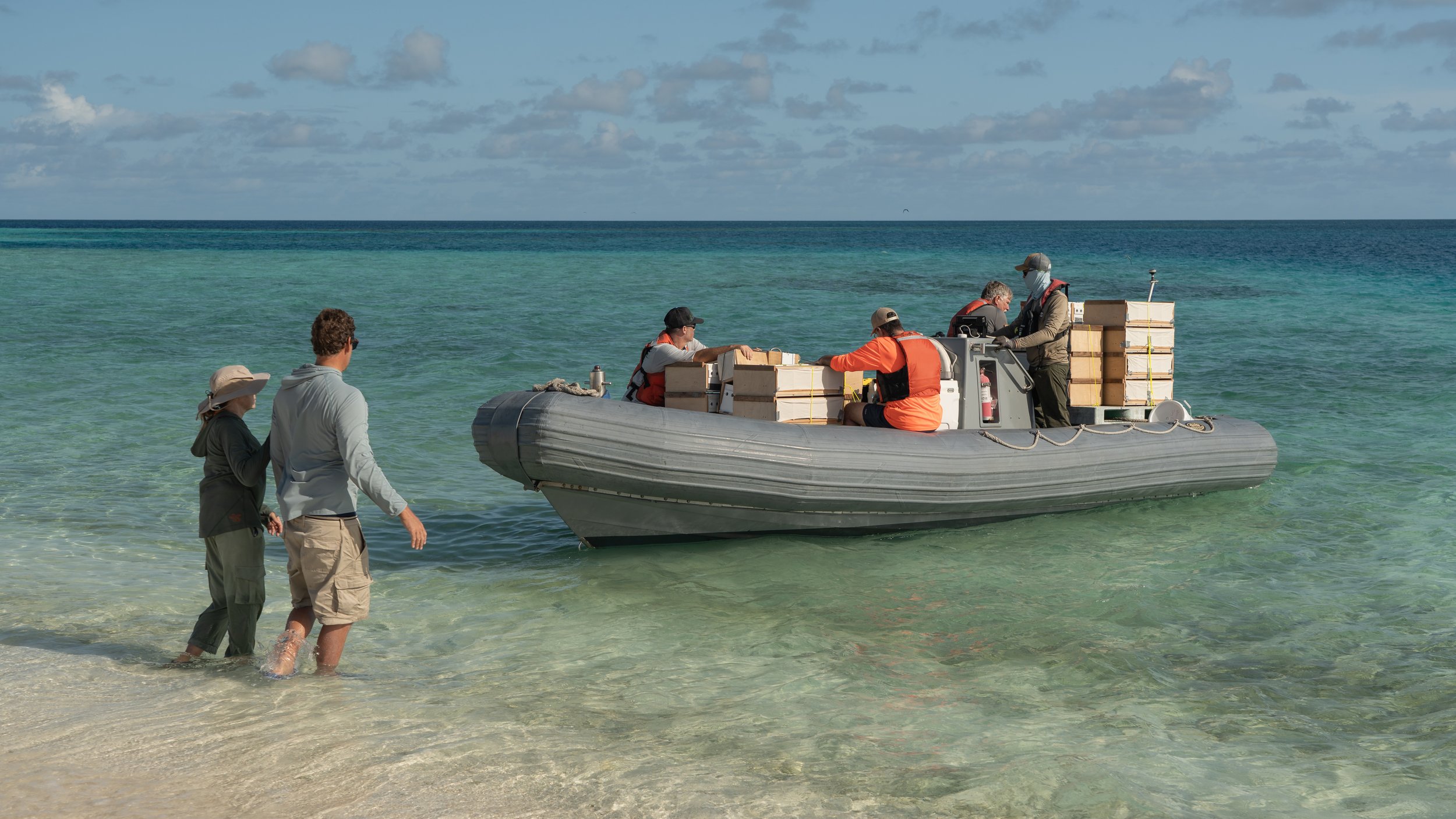

Field crews depart Manawai by zodiac, transporting ‘ekupu‘u to a larger vessel bound for Eastern Island. Upon arrival, team members carefully carry the transport boxes ashore for the final leg of the journey — their release into restored habitat. © Dan Rapp, USFWS
The voyage was just one piece of a much larger picture. This effort brought together multiple organizations and drew on the expertise of the U.S. Fish & Wildlife Service, NOAA, USGS, University of Hawai'i's Project VINE, Friends of Hawaiian Islands National Wildlife Refuge, Pacific Rim Conservation, Papahānaumokuākea Cultural Working Group, Pacific Bird Conservation, and the American Bird Conservancy. The Hawai'i Audubon Society provided a small, yet critical amount of fundraising through the Hawai'i Bird Crisis Fund, rallying community members and donors who understood the urgency of the birds' safety.
Upon arrival at Eastern Island, the finches were released into native habitat restored and protected in preparation for their return. Monitoring began immediately. Field teams will track banded birds, record feeding behaviors, and search for signs of nesting. The newly arrived population faced an early test when a tsunami swept through the atoll only days later. But the birds endured—an encouraging sign of resilience (Hawaii Public Radio, 2025). By establishing insurance populations, wildlife managers help reduce the risk of total loss from localized threats. And Midway benefits from having these feathered ecosystem engineers restored into the atoll's delicate balance.

Biologists release ‘ekupu‘u into restored habitat on Eastern Island during the July 2025 translocation. © Dan Rapp, USFWS
This reintroduction is part of a broader conservation strategy within the Papahānaumokuākea Marine National Monument, where restoring biodiversity and avian populations across the archipelago is key to safeguarding island ecosystems against future shocks (USFWS, 2025). This Laysan Finch relocation echoes the successful re-establishment of the Laysan Duck on Midway two decades ago. Further proof that with the right conditions, native species can reclaim lost ground.
The project reflects a belief that conservation is both a science and a shared cultural responsibility. Every donor who contributed, every volunteer who spread the word, and every field biologist who endured the challenges of remote island work played a role in bringing the song of the 'ekupu'u back to Kuaihelani. Their efforts remind us that while extinction can happen quickly, restoration—though it takes patience—can succeed.

A newly translocated and released ‘ekupu‘u foraging in its new habitat. © Dan Rapp, USFWS
The return of the Laysan Finch to Kuaihelani represents more than a recovery milestone and a biological success, but also a symbolic restoration of an ecological heritage lost for generations. The song of 'ekupu'u, once silenced, now echoes across Midway Atoll again, carrying with it a renewed hope for Hawai'i's native birds.
Originally published in ʻElepaio, Volume 85, Number 5 (September/October 2025).